

Cross-stitch fabric comes in three different types: Aida, even-weave and linen. All these are woven with an equal number of threads per inch on the weft and the warp.
They are defined by their thread ‘count per inch’ (ct) or ‘holes per inch’ (hpi), which goes from 11 to 40.
Aida cloth, my favourite cross-stitch fabric
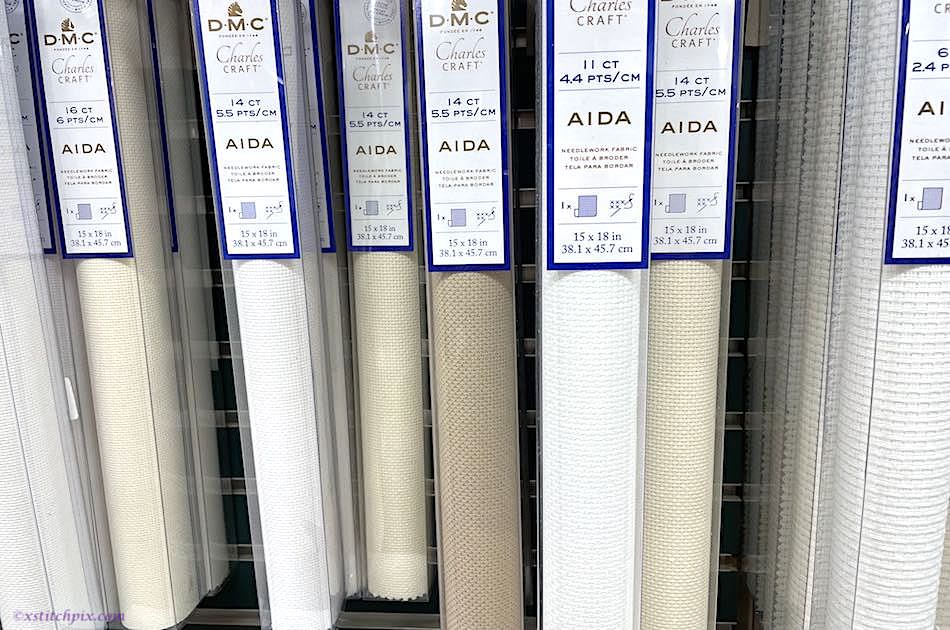
The most commonly used cross-stitch fabric is Aida, also known as Java canvas, a 100% cotton cloth invented by Zweigart in the early 20th century, available in most haberdasheries.
Aida cloth is made with an open, even-weave style. The horizontal and vertical threads form small squares delineated by a space (or hole) at each intersection that makes cross-stitching easy, in particular counted cross-stitch, as we stitch diagonally from a hole to another.
Aida comes in several counts ranging from 6 to 20, the most common being 14, 16 and 18 counts, or stitches per inch, which come in various colours ranging from white to natural.
Aida 20 is more difficult to source though, while Aida 6 is mostly used to teach children needle-crafts.
The lower the count number (i.e. 14 stitches per inch) the larger the space/hole will be.
You’ll need to use thicker floss (or more than two strands) so that the weft is not seen.
Conversely, Aida 18 will have smaller spaces/holes and you’ll be able to only use two strands of floss.
The other advantage of a higher number of stitches is that your design will be more detailed (a photo conversion works far better with an 18 count or higher obviously).
So I would recommend you start on Aida 14 if you are new to cross-stitch; it’s also the most common size available in haberdashery.
As you catch the ‘cross-stitching bug’, you’ll want to move on patterns designed for Aida 16, 18 and even 20 and over and on photo conversions before you know it!
Finally, Aida is a soft cross-stitch fabric, yet stiff enough to be worked on without using a embroidery hoop; however, it easily frays, so I always sew a ribbon over the edges.
Even-weave, a cross-stitch fabric alternative to Aida
Even-weave cloth is an alternative to Aida, which is the most commonly used cross-stitch fabric. It comes in several counts ranging from 6 to 20, which makes it perfect for all cross-stitch enthusiasts, from beginner to expert.
However, once you’ve become more experienced, are up for a little challenge or are simply looking for a different style you might want to cross-stitch on even-weave.
An even-weave (evenly woven cloth) has an equal number of weft and warp threads per inch, and all the threads have the same thickness.
Working on even-weave is slightly different from working on Aida, as you don’t count squares, but threads and normally work over two threads. This means that you skip a hole and put your needle in the second hole.
The most popular even-weaves come in 28, 32 and 36 counts, which correspond to Aida 14, 16 and 18 when you work over two holes.
That said, if you are enormously patient and up for a big challenge, you can work over one thread only; you will thus end up with 28, 32 or 36 stitches per inch, which is ideal for a photo conversion because many more details will be recreated.
Linen, the third cross-stitch fabric
Linen is another great cross-stitch fabric. This natural fiber has a wonderful old-fashioned appearance, especially when it comes in natural colour.
However, the variable thickness of linen threads affect the regularity of the stitches.
Linen comes in 18, 22, 26, 28, 30, 32, 35 and 40 counts and is worked the same way as even-weave, by stitching over one or two holes. It also comes in several colours.
The choice is yours, but whatever it is, the most important is that you don’t struggle but take pleasure in creating your pattern.
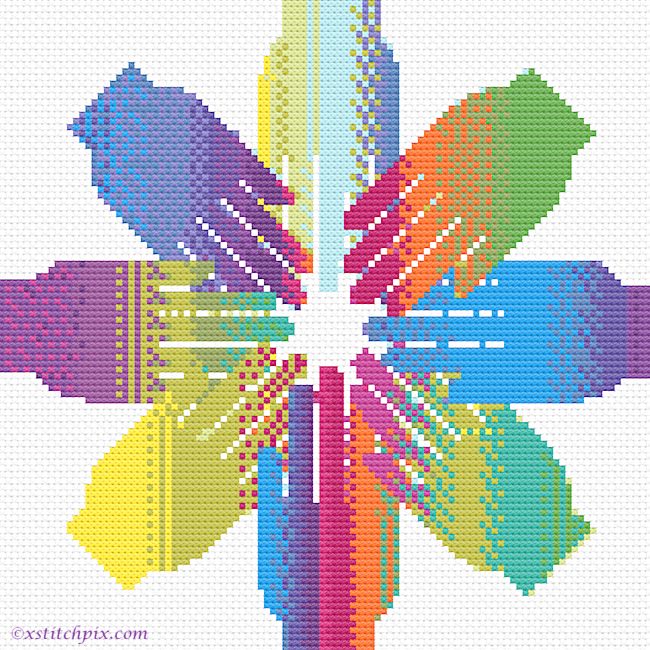
Example of my ‘Eight joined Rainbow hands’:
- Pattern width: 7.6in ± 19.2cm
- Pattern height: 7.5in ± 19cm
if I add 2.5in ± 6cm around each edge, I’ll add a total of 5in ± 12cm:
- Fabric width: 7.6in + 5in ± 12.6in OR 19.2cm + 12cm ± 31cm
- Fabric height: 7.5in + 5in ± 12.5in OR 19cm + 12cm ± 31cm
How do you choose the correct cross-stitch fabric size?
It’s very easy, as my PDF gives you the size of the pattern. You’ll just need to add some extra space (therefore fabric) around the edges of the pattern.
When cutting my cross-stitch fabric, I normally add about 2.5in (about 6cm) around each edge of my patterns, but you might decide to add slightly more depending on what you’ll do with your finished project afterwards.
For example, you might want to frame it, so in that case it’s better to add between 5in and 6in (about 12cm-15cm) on each side to give the frame shop people enough fabric to fold over.
Or you might turn your cross-stitch into a cushion, and in that case you’ll also need enough fabric to cover the front of your cushion.
Only you know!
In any case don’t add less than 2.5in ± 6cm on each edge, as you’ll find it tricky to hold your cross-stitch.
Let’s take the example of my Eight (joined) Rainbow Hands pattern:
Pattern width: 7.6in ± 19.2cm
Pattern height: 7.5in ± 19cm
So if I add 2.5in ± 6cm around each edge, I’ll add a total of 5in ± 12cm, and my fabric will have to be about:
Width: 7.6in + 5in ± 12.6in OR 19.2cm + 12cm ± 31cm
Height: 7.5in + 5in ± 12.5in OR 19cm + 12cm ± 31cm
N.B. My patterns don’t always come in round numbers due to the drawing conversion, so you’ll have to round up these numbers to the closest round number (or add more fabric if you need).
So there you are, you’ve cut your cross-stitch fabric to dimensions and have decided to stitch with 2-thread strands, you’re ready to get started…
So, Happy Cross-Stitching to You!


