

Rainbow stitches for a brighter day
My rainbow patterns collection is for everyone; those who simply love the colours of the prism, those who love the promise of sunshine after the rain and those who love its new symbolism.
This collection is a little off the beaten track because I like what’s different. I also like to go beyond received ideas because culture and society are in perpetual evolution.
The objects remain but their symbolic value changes according to time and trends. This makes us think outside the box and see things from a different angle, which is very beneficial for artistic creation.
The icing on the cake is that the rainbow design converts very well to cross-stitch and produces happy and bright patterns!
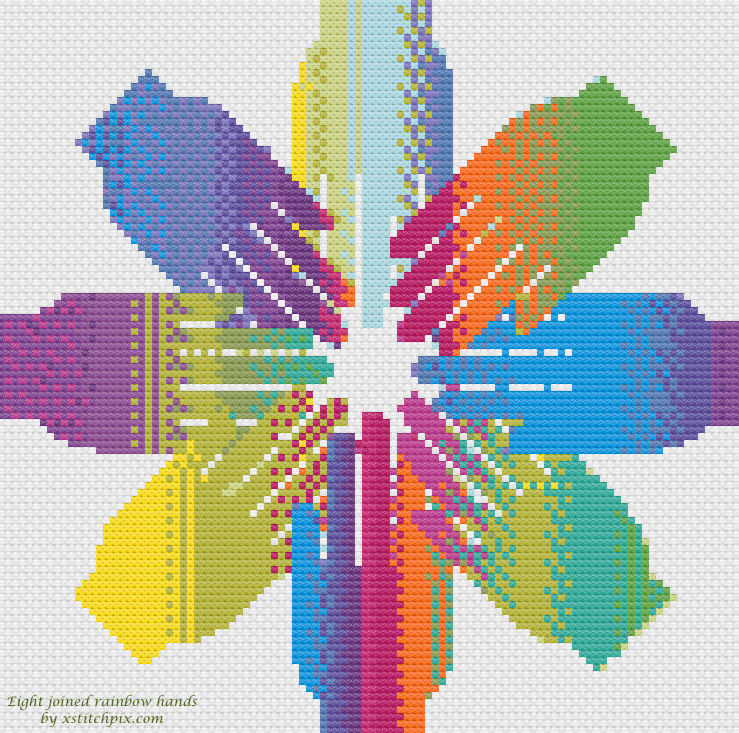
The divine rainbow
We all like to see a rainbow and many of us even consider it a lucky charm.
We sometimes even hope for rain so that the light reflecting, refracting and scattering in the water droplets suspended in the air can produce the fascinating arc. Optical illusion, intangible and magic, the rainbow then dissolves and evaporates, as if by magic.
It is not surprising that the ancients considered it to be of divine origin, an inaccessible place, a transient world that connected the world of the Gods to that of mortals.
Greek philosophers also believed that colours, musical notes, known objects in the solar system and days of the week were interconnected.
The human eye is able to differentiate about 100 colours in the light spectrum, but Isaac Newton (1642-1726) based himself on the Greeks’ belief in dividing and simplifying the visible spectrum into 7 identifiable colours: red, orange, yellow, green, blue, indigo and violet.
This sequence of colours never changes, as they always appear in the same order. Today’s newly accepted range of colours has replaced blue with cyan, and indigo with blue.
A symbol of diversity and harmony
Magical or divine, the rainbow is considered one of the most beautiful weather phenomena in the world and became a universal symbol in the late 1970s.
The artist Gilbert Baker created the rainbow flag to represent diversity and harmony.
The gay community adopted it in 1978 as their emblem after it was displayed during San Francisco’s Gay Freedom Parade. Until then, the movement’s emblem was the pink triangle, which, tragically, the Nazis used to mark out gay people.
The rainbow flag was immediately adopted as the emblem of the LGBTQ community. However, it was not until the mid-1980s that everybody, all around the world, knew its meaning and significance.
However, Baker’s flag was different as it featured bright pink and two different shades of blue.
All colours had their symbolism: bright pink represented sexuality; red was the colour of life; orange the colour of healing; yellow for the sun; green represented nature; blue was for art and indigo for harmony or serenity and violet for the human spirit.
The colours changed over the years.
Pink disappeared for the simple reason that it was impossible to source the fabric required for mass production.
Indigo and turquoise were fused into royal blue on the occasion of the protest parade that took place after the assassination of Harvey Milk, so that each side of the processional route would be lined with an even number of colours.
The city of Philadelphia added brown and black in 2017 to include the gay community of colour and erase the racial divide that existed in the movement.
It is important to know, however, that the rainbow flag was originally invented to include everyone, people of all skin colours and sexualities and that flying the rainbow flag today does not necessarily mean that one is gay, but that one is tolerant and accepting.
The colours of the rainbow have today become a worldwide symbol of unity and I hope you’ll enjoy discovering my rainbow patterns.
Happy cross-stitching to you.


